Before · two agents
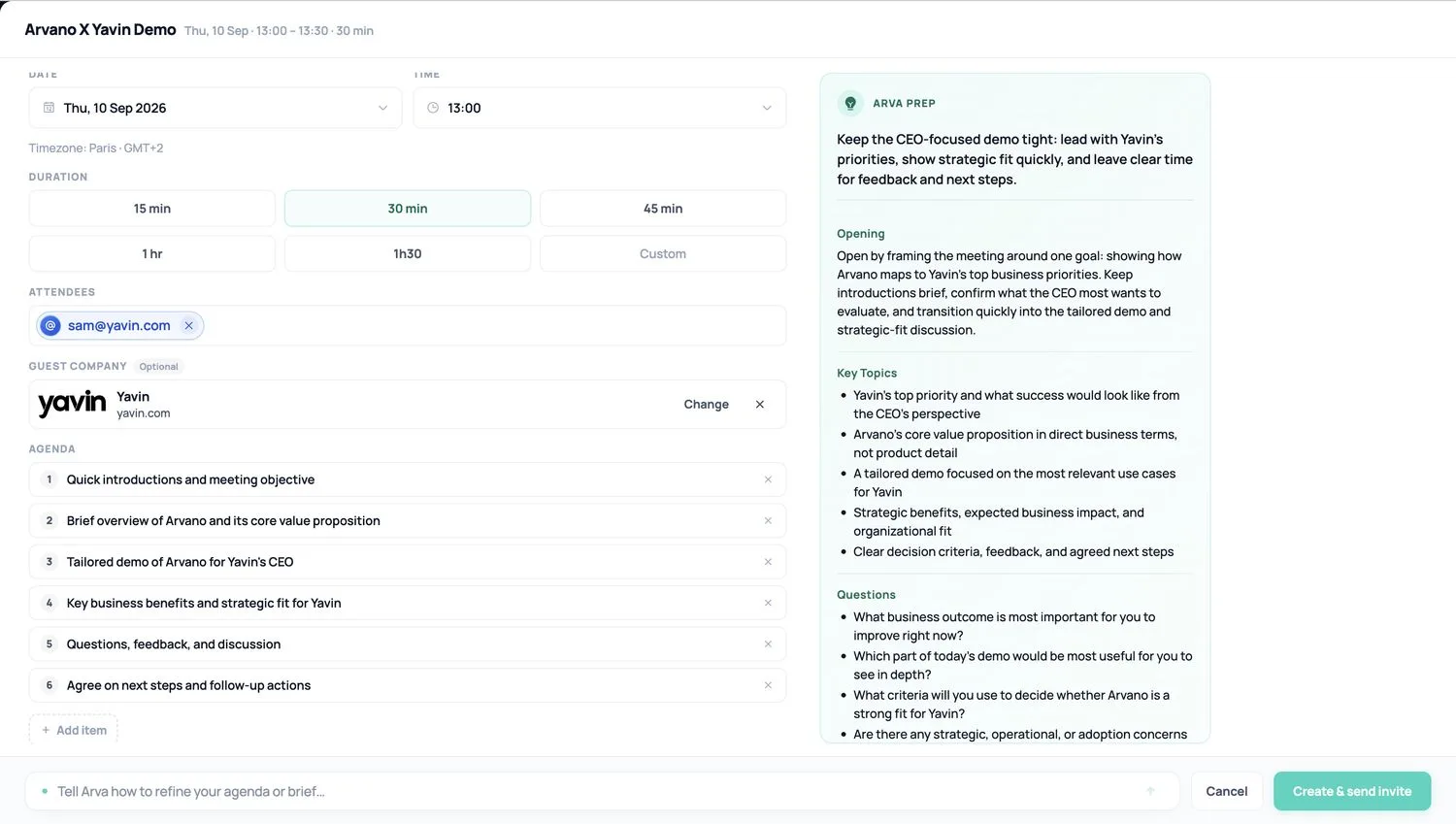
The agenda, then a brief on what your company already knows about the account.
Vertex · 14:00 · pre call brief
Reps spend 60% of their time on work that is not selling. Research, objections they have to guess at, notes, follow ups, scheduling. Eight agentic AI agents take that back.
 Victor D.
 Anna F. (You)
+33 7 56 12 04 88
Acme Corp
Sales teams running on Arvano.



 ReverseLooker
“A member of our team signed our company’s biggest customer thanks to the live Arvano agent helping during his calls.”
Can you name the five objections that cost you the most deals?
Do you know the five features your prospects ask for most?
Do you know exactly what makes you lose deals to one specific competitor?
Does your whole team answer the price objection the right way?
Your team knows all four. It just does not reach you.
Two before the call. One during it. Four after it. And one they can talk to whenever they want.
Before · two agents
During · one agent
After · four agents
Any time · one agent
It belongs to no moment. Your reps ask it for a past conversation, a coaching read, a slot in their calendar, a follow up rewritten. It books, it logs, it edits, and nothing happens without your rep’s approval.
Not a tool you add on top of your calls.
It is the calls themselves.
“The Arvano weekly report tells me where our team has lost winnable deals, and prioritises the features our prospects ask for.”
Support uses it. Finance uses it. Your Monday standup uses it. Which means it is set for none of them in particular, and the one conversation that decides your quarter runs on a general purpose tool.
For any of it to change anything, it has to be inside the conversation while it happens, and it has to come back out as a follow up that actually goes.
Without Arvano
With Arvano
Before it
He walks in with whatever he remembers about the account. No briefing, nothing your company already knows.
The brief he opened the call with, on everything your company already knew about Acme.
During it
The objection lands and the answer has to come in four seconds. He is on his own.
The answer that reached him when they pushed back on price, four seconds after they did.
After it
Notes to write at seven in the evening that nobody will ever read. A note in the CRM, a next step logged, a follow up sent. Maybe.
The notes, the follow up sent that afternoon, the next step logged before he opened another tab.
And on your side
Nothing. You were not in the room, and nothing about your own market ever reaches you.
Acme is the fourth account this month to ask for a Salesforce integration. Five of your last ten losses had the same pricing objection in the call.
Replaces
Four windows become one. The phone sits inside your CRM, a rep calls by clicking the contact he was already looking at. The video link is generated from your calendar and your forms, it is in the invite before anyone thinks about it.
Integrates
HubSpot, Pipedrive or Salesforce. Google Calendar. Nothing to migrate, nothing to rebuild. Your reps do not have to learn anything, and nothing else about their day changes.
Yes, for the sales team. That is the condition for the eight agents to work with your reps at all times, not just after the call.
For the demos and meetings your team runs, yes. Prospects join a link, nothing to install and nothing to invite into the meeting. Same reason: the agents have to be inside the conversation, not watching it from outside.
Good, you are already ahead on AI adoption. You are running one agent out of eight, and the one that works after the conversation is over. The seven others work before the call and during it, while a deal is still winnable.
We do it. You send us three to five follow up emails your team has actually sent, the call types you run and your red lines. We spend the half day, not you. That is what turns eight generic agents into eight agents that know your products, your objections and what a rep may never say.
They open one window instead of four. The phone sits in your CRM, the video link is in the invite before anyone thinks about it. The eight agents work around them without being asked.
$110 per seat per month, plus a one off setup fee for building your agents. Full detail on the pricing page.
Thirty minutes on your process, your objections and your pipe. You leave knowing where the eight agents would sit in your cycle, and where they would not.
Not one assistant asked to do everything. Here is exactly what each one does, and what stops it doing anything you did not ask for.
Any time · one agent
Around fifteen tools on your rep’s own data. It belongs to no moment, your reps talk to it whenever they want, and nothing happens without their approval.
Before · two agents
Builds the agenda from the meeting details and whatever your rep says he wants out of it. He can ask for a revision, add a pricing discussion, cut it down, and it rewrites.
Turns that agenda into a pre call brief: a summary and four structured sections on what your company already knows about the account.
During · one agent
Holds your entire knowledge base and answers a single question, over and over: is there something useful to say right now. Most of the time the answer is no.
After · four agents
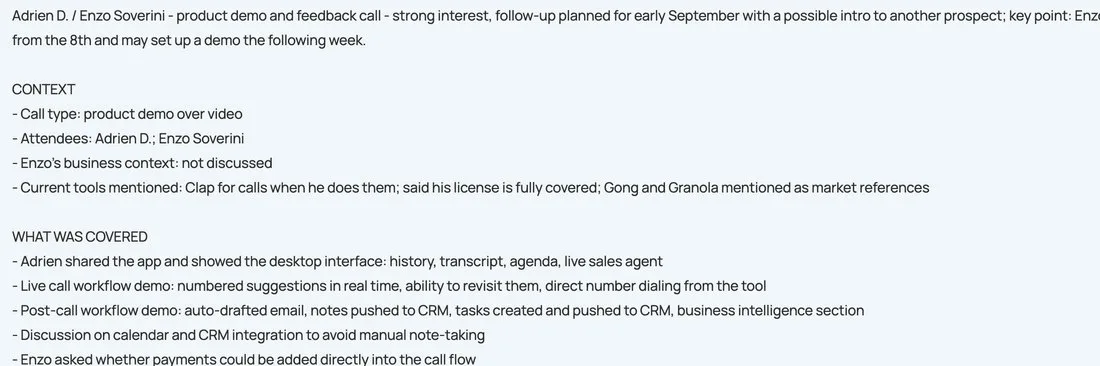
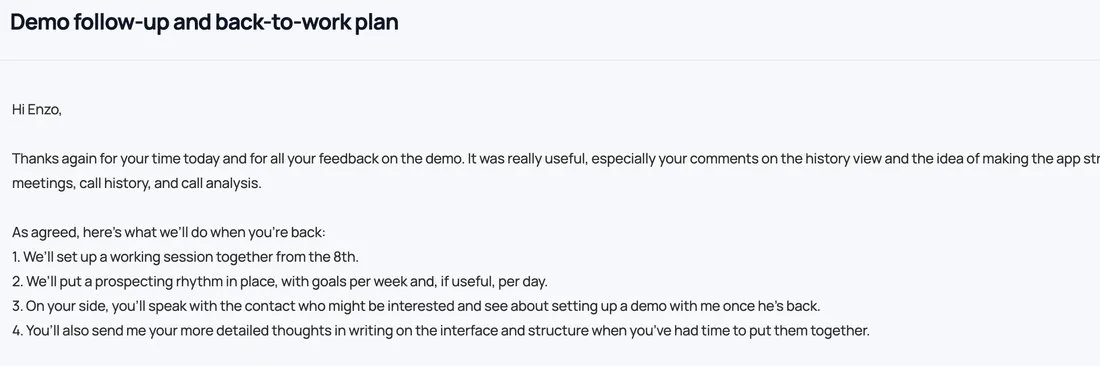
All four run at once the moment the call ends. The follow up in your team’s voice, the structured write up, exactly one task, and the read of the call. Pushed into HubSpot, Pipedrive or Salesforce.
The agenda agent
builds the agenda from the meeting details and whatever your rep says he wants out of it. He can ask for a revision, add a pricing discussion, cut it down, and it rewrites.
The brief agent
turns that agenda into a pre call brief: a summary and four structured sections on what your company already knows about the account.
The conversation is transcribed as it happens. At intervals, the current state of it goes to an agent that holds your entire knowledge base in memory: your offers, your pricing rules, your integrations and their status, your competitors, your reference clients, your onboarding. That agent answers one question each time.
Right now, do I have something useful to say, or do I stay quiet?
Staying quiet is the hard part
An assistant that talks constantly becomes wallpaper and your reps stop looking at it within a week. So before it is allowed to speak it has to pass a test written into its instructions: can it name one specific thing said in the newest exchange that the rep has not already handled? If it cannot, it stays silent.
Four things make it look
Two levels
A card is large and prominent: act on this now. A note is small, quiet and fades: worth knowing.
What it contributes
A competitor named, a piece of hardware, a tool they already run on, an integration. The exact answer is in its knowledge and reaches the rep in two to three seconds.
It knows the transcript lies
Live transcription mangles names, numbers and company names. When a detail matters and looks wrong, it tells the rep to confirm it. It never repeats it back as fact.
Drafts the follow up. The voice is not described to it, it is copied: we build this agent from three to five emails your team has actually sent. Adjectives like professional but warm measurably do not work. Real examples do.
Notes
The structured write up, in the sections your company actually uses.
Tasks
Exactly one follow up task, never a list. A list of five gets ignored, so the agent picks the single most important one and sets its deadline.
Analysis
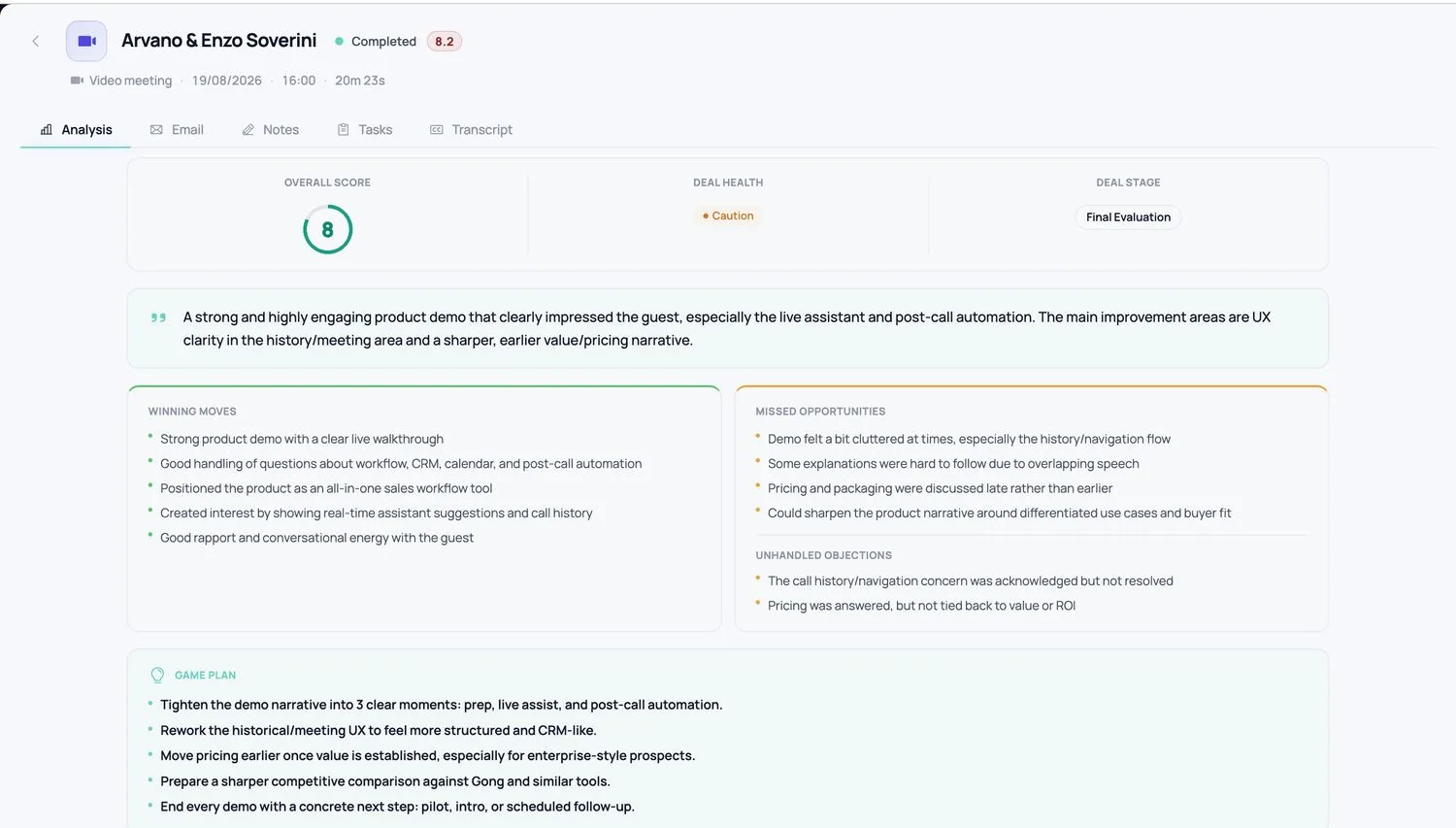
A one line summary, a quality score, buying signals, objections handled and mishandled, risk, deal stage and probability, engagement, competitive positioning, and coaching points. The summary and the score attach to every call in the history and in the manager’s view.
Reading
The follow up draft for a past call. His coaching profile. CRM contacts and deals. Past conversations with a given person or matching a phrase. Meetings in a time window. Free slots in his calendar.
Acting
Schedule a meeting with the join link and the invite. Move, edit or cancel one. Log a note or a task in the CRM. Regenerate a follow up draft.
It never acts on its own. Any tool that writes something stops and returns a confirmation card. It is structurally unable to report a job done before a human has clicked, and it cannot quietly retry.
A separate process reads the analyses of a rep’s calls and groups them into recurring themes. Consistent strengths, consistent weaknesses, objections repeatedly mishandled, with trends over time. That becomes what the rep works on next, and where you see your team standing.
Every company gives us things a customer must never see. Partners, suppliers, margins, competitive intelligence, topics not yet approved for reps to discuss.
Those facts stay in the knowledge base and the agents reason with them. What is blocked is their appearance in anything customer facing. An agent can know that a product is white labelled from a supplier, use that to answer correctly, and never name the supplier in an email.
There is a defined intake, and three parts of it can only come from you.
One
The single highest value input. This is where the voice comes from.
Two
And for each one what a good outcome looks like, plus anything your process mandates after it. Always update the CRM. Always book the thirty day review before hanging up.
Three
What a rep is not allowed to assert. Forbidden vocabulary. Whether a price may ever appear in an email. The confidentiality wall.
The rest, your product facts, your competitors, your reference clients, we build from your website and your public documentation, and you validate it. Everything ends up in per company files that are versioned and revisable.
Agent instructions are never edited live on your account. Every change runs through a test bank first.
We ran the sales floor before we built the tool. One to five million ARR carrying a bag, then five to eight running marketing, and the person who builds the system sat next to it the whole time.
Which is why Arvano is not a layer of AI added on top of a stack. It is one platform, with agents written for your company, working alongside your team during the conversation instead of reporting on it afterwards.
Thirty minutes on your process, your objections and your pipe. You leave knowing where the eight agents would sit in your cycle, and where they would not.
A team of eight agents with your reps, all the time. Phone, video and unlimited calling. Your CRM and your calendar connected. One line on your invoice instead of three.
Need phone and visio? Talk to us.
Plus, once
Depending on the integrations we build for you. Six month minimum. Twelve or twenty four months cost less per seat. The variation lives in the setup, never in the licence, so nothing this site promises becomes a paid option.
What you pay today
What you pay with Arvano
We do it
We go stage by stage through your sales process, your qualification, your objections and your pricing, we build your agents from it, and we connect Arvano to the tools you already run on. We spend the half day, not you.
What we need from you
A setup that takes two minutes gives you a template. This is what turns a summary into an answer.
Yes. Unlimited phone and video, no per minute billing.
No. Arvano is set on your sales process before your team touches it, and a version that is not set on your process is not Arvano. The demo runs on a real call instead.
No. Start with the reps you want.
Six months minimum. Twelve or twenty four months cost less per seat.
Thirty minutes on your process, your objections and your pipe. You leave knowing where the eight agents would sit in your cycle, and where they would not.